

Arena Holdings learns reaching millions isn’t the same as serving them
Conference Blog | 08 October 2026

For years, scale was a key measure of success for news publishers. For Arena Holdings in South Africa, it still matters, but it no longer tells the whole story.
“If you had asked me probably a year or so ago what makes this business tick, I probably would have said very proudly that we reach millions of people,” Nwabisa Makunga of Arena Holdings, told attendees at the recent INMA Africa Audience Development Summit.
After a year of “interesting and sobering lessons,” Arena is asking a different question: What do its audiences actually value?
Across a portfolio that includes the Sunday Times, TimesLIVE, Business Day, and Sowetan, that means looking beyond differences between brands. Even within a single publication, audiences have different interests, behaviours, and expectations.
People are also more selective about what they consume, where they consume it, and how much time they give it.
“Audiences have become a lot more self-directed,” Makunga said. “Audiences have become very much selfish as far as their time is concerned, what they consume, and how they consume it.”
That shift challenges the traditional mass-reach model. “Mass distribution no longer guarantees a meaningful consumption,” she said. “Brand loyalty can’t be assumed.”
Instead, relevance has to be continually earned.
“The idea that you have to constantly be asking about your relevance, and earning that relevance consistently, is really the work that we all need to put in,” Makunga said.
5 audience questions
For Arena, that means putting greater emphasis on engagement and asking five questions about its audiences:
What does it know about them directly? Who are they? What matters to them? How do they behave? And what value are they seeking from a particular brand?
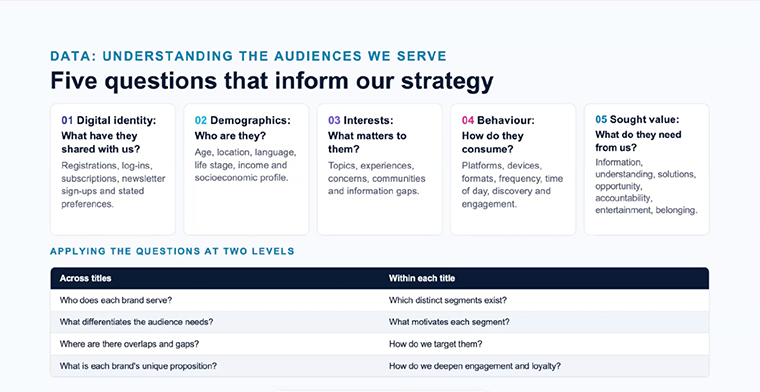
Data sits at the center of that process because, Makunga said, “it helps us to make credible decisions.” But the numbers also have to be understood alongside audience experiences.
That can challenge assumptions inside the newsroom.
“I’ve been an editor and editors will tell you, ‘I think I know best what my audience is,’ but do you really?” Makunga said.
Arena applies those questions across its portfolio and within individual brands. The Sunday Times, for example, does not have one uniform audience. Different communities come to the same publication for different reasons, requiring the publisher to understand what motivates each segment and how to deepen its engagement.
Utility journalism at Sowetan
Sowetan offers a clearer example of how those insights can shape editorial decisions.
Arena combined its own audience data with external research to understand who it wanted to serve, what interested them, and how they behaved. While Sowetan had historically been strong on crime and safety, football and entertainment, the research revealed a growing appetite for utility journalism.
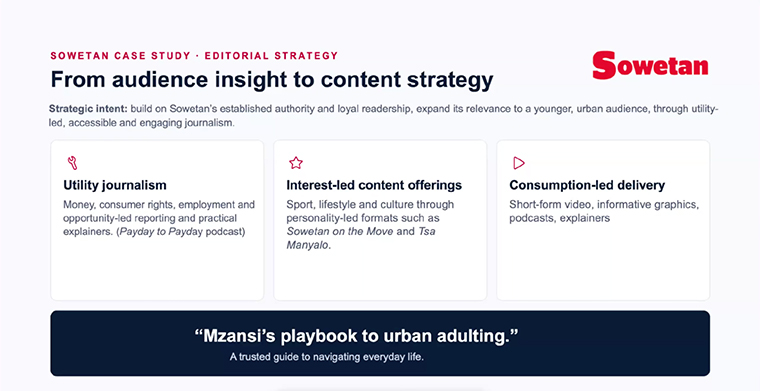
Readers wanted practical information about money, jobs, and side hustles. Consumer affairs also generated strong engagement because it helped people navigate everyday problems.
“You would really see people engaging with that kind of content because it’s very much about them navigating life essentially every single day,” Makunga said.
The same applied to governance. Audiences were interested not only in high-level issues but in what was happening on their own streets and how institutions could be held accountable.
Understanding the questions audiences ask, including outside Arena’s own platforms, helped uncover those needs.
In one striking example, data showed one of the top questions people were asking during one month was where to buy an illegal gun in South Africa. Rather than answering the query literally, Arena looked at the concern behind it.
“If you turn that question around and you say, that means there is a much deeper concern about safety,” Makunga said, the question becomes what journalism can help people “be informed and be empowered in terms of how to keep themselves safe.”
The insight was not the search query itself but the underlying audience need it revealed.
Arena also looked at when and how audiences consumed content.
For Sowetan, research identified strong commuter patterns. In the morning, readers wanted quick updates. By mid-morning, consumer-oriented content generated stronger engagement, while access to workplace Wi-Fi created opportunities for more data-heavy video and audio.
At home, readers had more time for longer how-to, food, cooking and lifestyle content, with Arena seeing deeper scroll depth. Breaking news, meanwhile, worked better when it was short and visual.
Understanding an audience, then, is not only about identifying topics of interest. It also means understanding when people consume journalism and which formats fit those moments.
Arena eventually distilled what Sowetan’s audiences wanted into several needs: inform me, guide me, empower me, represent me, entertain me, and hold power to account.
“Guide me” was particularly important, Makunga said. So was “represent me” — helping readers raise concerns and seek accountability.
She recalled a consumer story involving a reader who had been overcharged for a license. After the newsroom became involved, the issue was resolved within hours, prompting others to come forward with similar complaints.
These insights helped sharpen Sowetan’s focus on utility journalism: content people could use to navigate everyday life.
Putting insight into practice
But translating audience insight into newsroom practice is an ongoing process.
“We don't have it right all the time,” Makunga said. Teams might get it right one month and slip back into old habits the next. “But I think it's a constant pushing.”
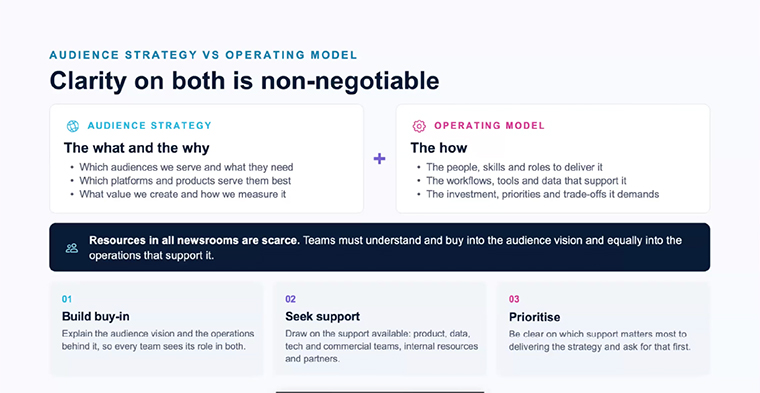
For Sowetan, the research kept returning to the same finding: “People were looking for something that they can actually use.”
Making that approach sustainable requires clarity inside the newsroom as well.
Makunga identified two priorities:
The first is audience strategy: Which audiences are we serving? What do they need? Which products and platforms work best for them?
The second is the operating model: Teams need to understand those priorities, and workflows need to support them. Without that alignment, journalists can be pulled between competing demands rather than working toward a shared audience goal.
Banner photo: Adobe stock image by Best.
Related Articles
-

WSJ executive councils show how publishers build communities th...
19 October 2026 -

AI’s effect on super user math
15 September 2026 -

At Mediacorp’s CNA, loyalty means giving audiences a reason to ...
20 August 2026 -

Tribun Network turns print “dots” into AI-powered insight
20 August 2026 -

Nation Media Group focuses editorial strategy on stories that m...
4 August 2026 -

Indian Express builds a video-first future around trusted journ...
20 July 2026 -

Economist launches subscription tier targeting younger audience...
20 July 2026 -

Grupo RBS builds social-first video operation to expand audienc...
20 July 2026
Upcoming Events
-

Subscriber Acquisition Master Class
10-17 November 2026
-

Media Advertising Summit
New York, United States
07-10 December 2026
-

AI-Native News Product Master Class
18-25 February 2027
-

Media Subscriptions Summit
Oslo, Norway
08-12 March 2027
-

World Congress of News Media
New York, United States
25-30 April 2027
-

Branded Content & Partnerships Master Class
20-27 May 2027
-

Subscriber Retention Master Class
17-24 June 2027
-

Conferencia Latinoamericana
15-16 July 2027
-

South Asia News Media Festival
New Delhi, India
19-22 July 2027
-

Asia/Pacific News Media Summit
19-20 August 2027
-

CEO Roundtable at Kilkenny
Kilkenny, Ireland
24-26 August 2027
-

Media Innovation Week
Amsterdam, The Netherlands
27 September - 01 October 2027