
Inside MK Media Group’s AI transformation journey
Conference Blog | 25 August 2026

For news publishers, the AI challenge is no longer simply about keeping up with the latest technology. It is about deciding where AI belongs in the business — and where it does not.
At Maekyung Media, that process has meant moving from early experimentation to practical applications across search, audio, financial intelligence, and reader engagement, while keeping credibility and human editorial oversight at the centre.
During the recent INMA Asia-Pacific Media Summit 2026, Suho Park, a journalist working on the group’s AI transformation task force, outlined how one of South Korea’s leading comprehensive media groups is embedding AI into its products and workflows.
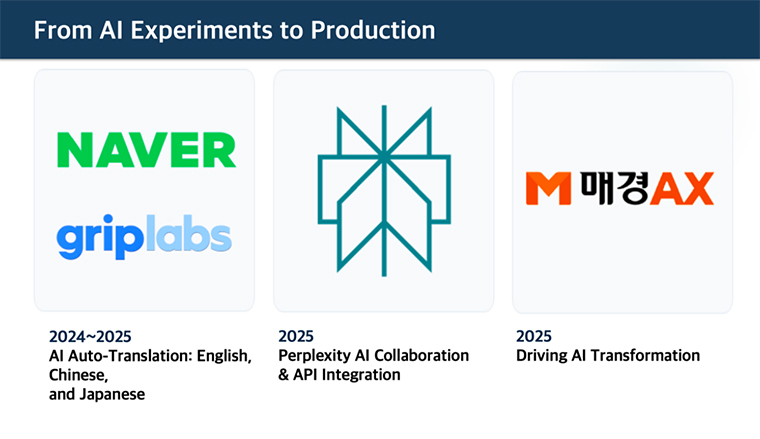
The journey accelerated after ChatGPT’s arrival in late 2022, when Maekyung recognised the potential impact of generative AI and began moving toward broader integration. Its early applications included AI-powered translation, with its official portal offering real-time news translation into English, Chinese, and Japanese.
In 2025, the group partnered with Perplexity to integrate its AI technology across Maeil Business Newspaper and MBN, while its digital operation MKAX became a core hub for group-wide AI innovation.
But the evolution is not simply about adding AI tools. Maekyung is increasingly asking where AI can solve real problems for both readers and journalists.
Turning a 60-year archive into an AI knowledge engine
One of the clearest examples is Maekyung’s AI knowledge search.
The group’s archive spans six decades and nearly 10 million articles. Rather than treating that archive as a static repository, Maekyung has built an AI search experience that allows readers to ask questions in natural language and receive answers grounded in the organisation’s own journalism. The system provides citations and direct links to the original articles behind the answers.
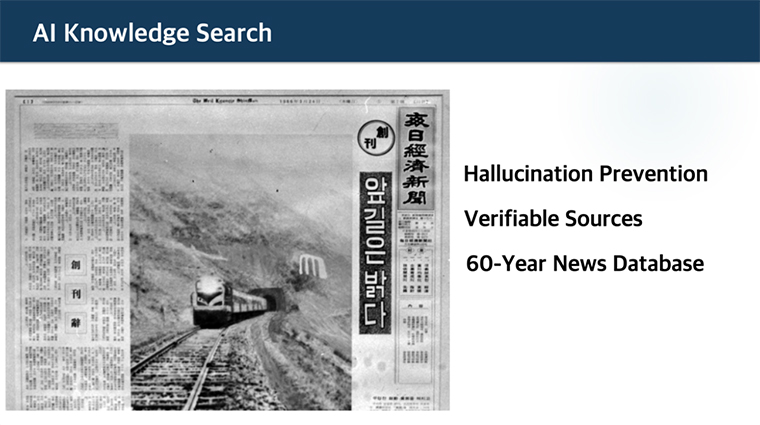
That approach reflects two principles that Park highlighted: credibility and attribution.
Hallucination remains one of the major risks associated with GenAI. Maekyung’s response has been to engineer its system to retrieve and synthesise information strictly from its verified database, while allowing readers to identify the specific articles supporting an answer.
“Building reader trust in AI-generated output is paramount,” Park said.
The distinction is important. Rather than asking AI to create journalism from scratch, Maekyung is using it to make its existing journalism easier to access and understand. Its archive becomes an active information resource, allowing readers to connect current questions with historical reporting.
From AI experiments to production workflows
Maekyung is also applying AI directly to content production.
Its MAI service is an AI-powered suite designed to help audiences interact with news, data, and financial insights. It includes a news agent offering personalised briefings, deeper explanations, and conversational search; an investment assistant combining financial data, corporate disclosures and analytical journalism; and an economic education agent that turns complex economic concepts and news developments into more accessible learning materials.
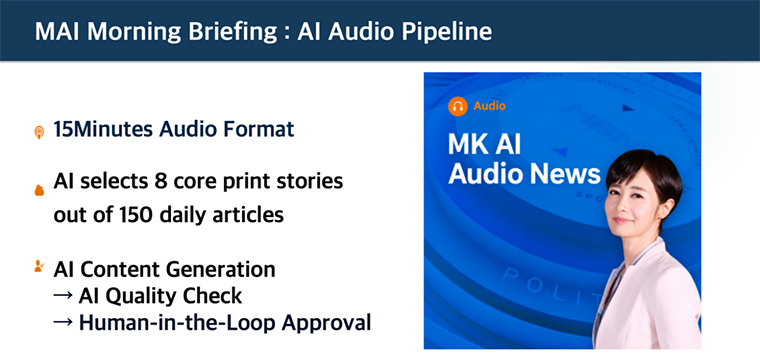
Another example is its AI-powered morning briefing. Every day, AI selects eight key stories from around 150 print articles and turns them into a 15-minute audio programme featuring an anchor and reporting journalist. The production process is automated from story selection and scriptwriting through voice synthesis.
Yet automation does not mean removing journalists from the process. Maekyung has introduced a multi-stage validation framework in which AI-generated scripts are first checked by a secondary AI system and then go through mandatory human-in-the-loop approval before publication.
This is where the transition from experimentation to application becomes particularly visible. AI is no longer simply being tested as a standalone tool, but being integrated into an end-to-end workflow, with defined quality controls and editorial responsibility.
Measuring AI by reader utility
Perhaps the most important strategic principle Park shared was that Maekyung “prioritises reader utility over direct AI novelty.”
The goal is to change the nature of news consumption from passive reading to active engagement. Readers should be able to explore context, ask follow-up questions, and test their understanding rather than simply consume an article and move on.
Park described this transformation as moving from “read” to “explore,” with AI-powered news designed to support deeper understanding, continuous learning, and smarter decisions.
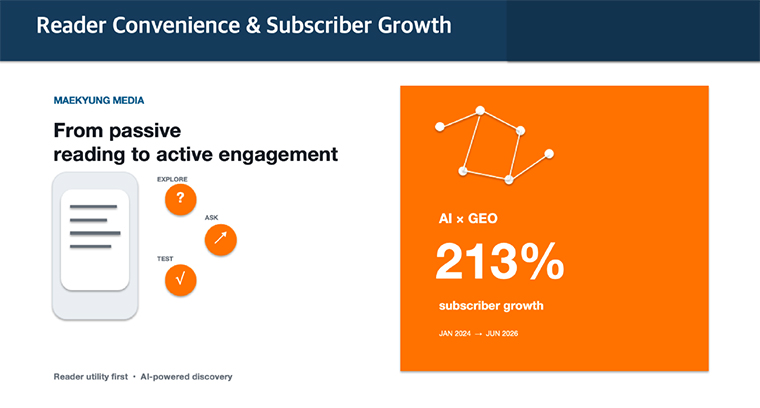
Maekyung has seen measurable audience growth alongside its AI efforts. Cumulative subscribers to the main business newspaper Web site increased by approximately 213% between January 2024 and June 2026. Park said improved reader convenience through AI adoption was one factor contributing to the growth.
That emphasis on utility also connects to Maekyung’s wider monetisation strategy. The organisation is investing in premium content and specialised verticals, including financial and real-estate content, while developing YouTube channels and other platforms to engage younger audiences.
In other words, AI is being positioned not just as a cost-saving technology, but as part of a broader effort to make Maekyung’s journalism more valuable to audiences.
From publishing articles to powering knowledge
Park ultimately framed Maekyung’s AI transformation as something much larger than a collection of products or experiments.
He posed a fundamental question for the industry: “In the AI era, is media company still a publisher of an article, or should it become a trusted knowledge engine?”
For Maekyung, the direction is increasingly clear. Its AI strategy is built around making trusted journalism more interactive and useful.
“The future of media is not just to publish news, but to turn trusted journalism into an interactive knowledge engine,” Park said.
For Maekyung, the journey from experimentation to application is ultimately about changing the role of the media organisation from producing individual articles to building a trusted layer of knowledge around them.
“From publishing articles to powering knowledge, that is where we believe the future of media lies,” Park concluded.
Banner photo: Adobe Stock by AREE.
Related Articles
-

Marketers should outsource tasks, not thinking
25 October 2026 -

Bundling is a pricing decision, rebundling is an organisational...
18 October 2026 -

AI’s effect on super user math
15 September 2026 -

At Mediacorp’s CNA, loyalty means giving audiences a reason to ...
20 August 2026 -

Tribun Network turns print “dots” into AI-powered insight
20 August 2026 -

Nation Media Group focuses editorial strategy on stories that m...
4 August 2026 -

Briefly News empowers journalists with AI tool suite Nova
4 August 2026 -

Indian Express builds a video-first future around trusted journ...
20 July 2026
Upcoming Events
-

Subscriber Acquisition Master Class
10-17 November 2026
-

Media Advertising Summit
New York, United States
07-10 December 2026
-

AI-Native News Product Master Class
18-25 February 2027
-

Media Subscriptions Summit
Oslo, Norway
08-12 March 2027
-

World Congress of News Media
New York, United States
25-30 April 2027
-

Branded Content & Partnerships Master Class
20-27 May 2027
-

Subscriber Retention Master Class
17-24 June 2027
-

Conferencia Latinoamericana
15-16 July 2027
-

South Asia News Media Festival
New Delhi, India
19-22 July 2027
-

Asia/Pacific News Media Summit
19-20 August 2027
-

CEO Roundtable at Kilkenny
Kilkenny, Ireland
24-26 August 2027
-

Media Innovation Week
Amsterdam, The Netherlands
27 September - 01 October 2027