

Research shows African audiences combine traditional and digital media
Conference Blog | 07 October 2026

African audiences are moving between traditional and digital media rather than abandoning one for the other, TIFA Research CEO Maggie Ireri told attendees at the recent INMA Africa Audience Development Summit.
Ireri challenged assumptions that digital platforms are replacing traditional media, radio is dying, and Internet use is concentrated among young people. She also highlighted geographical inequalities in digital access and differences between the platforms people use to discover news and those they trust.
Her central message for newsrooms was to plan radio, television, social media, and other online platforms as one ecosystem while recognising each medium can serve a different audience need.
Afrobarometer data presented by Ireri showed radio remained an important source of news across 38 African countries in 2024/25: 59% of respondents obtained news from radio every day or a few times a week, while television and social media each reached about half of respondents at the same frequency.
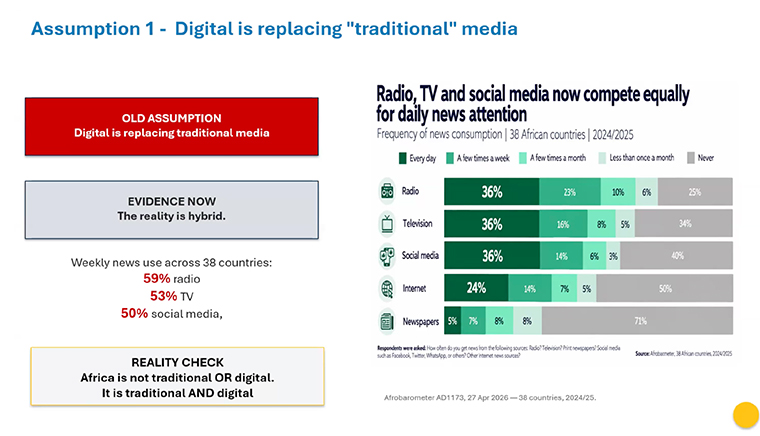
“The reality is hybrid,” Ireri said. “It is not an issue of talking about whether it’s traditional media or digital. It’s actually saying it’s a combination of traditional media and digital media.”
Kenyan figures presented during the session showed a similar pattern. In the latest quarter displayed, labelled Q4 2025/26, 75% of respondents had accessed radio during the previous seven days. Television reached 74%, compared with 57% for the Internet, 17% for newspapers, and 6% for magazines.
Data from the Communications Authority of Kenya also showed audiences combining platforms. In Q4 2025/26, 29.6% used radio, television and online media, while 17.8% used radio and television, and 16.4% used radio alone.
The findings showed why news organisations should stop treating traditional and digital media as substitutes, Ireri said. Instead, they should examine how audiences move across channels and assess the combined and additional reach delivered by each platform.
Radio retains its role
Ireri also challenged the assumption that radio is becoming irrelevant as advertisers direct more money towards digital platforms.
Although radio has lost some ground, she said, it continues to provide broad reach, particularly in rural communities.
“Don’t write off radio,” she said. “Use radio and digital together, and then plan by audience.”
Responding to a question about radio’s resilience, she said radio sets were less expensive than television sets and could operate on batteries in areas without reliable electricity. Community stations also provide local content in languages familiar to their audiences.
Internet access, by contrast, requires people to purchase data bundles, which can restrict consumption, particularly when they watch video.
Digital spans generations
Ireri also disputed the view that digital audiences are predominantly young.
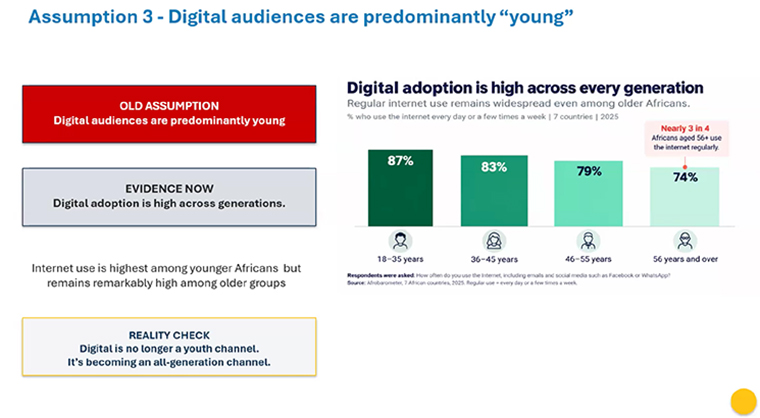
Afrobarometer data covering seven African countries in 2025 showed regular Internet use remained high across the age groups surveyed. Among respondents aged 56 and older, 74% used the Internet every day or a few times a week.
Ireri recalled meeting four men in their 70s in a rural part of Kenya who said they no longer bought newspapers because they obtained news online. One told her that by the time television news aired in the evening, he had already consumed the news on his phone.
“Digital is no longer a youth channel,” Ireri said.
She urged news companies to include older people in their digital plans while adapting their choice of platforms, content, and formats to the behaviour of different generations.
Geography shapes access
Growing Internet use has not eliminated the divide between urban and rural audiences, Ireri said.
The Afrobarometer figures she presented showed social media regularly reaching 65% of urban audiences in 2024/25, compared with 34% of rural audiences. Television also recorded a substantial divide, reaching 69% of urban audiences and 35% of rural audiences. Radio was more evenly distributed, reaching 59% in urban areas and 60% in rural areas.
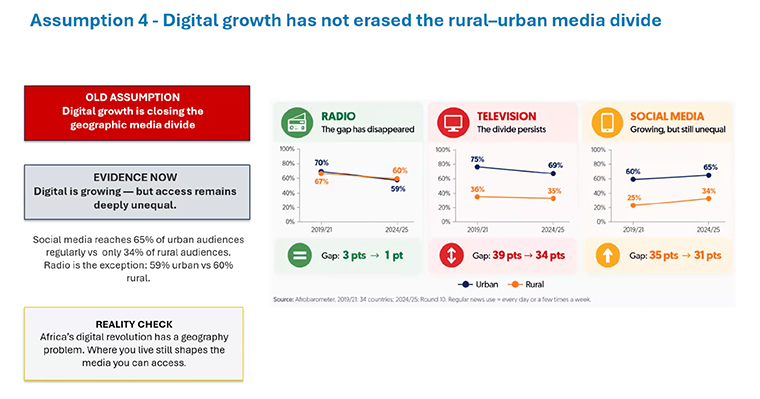
“Where you live shapes your media access,” Ireri said.
She advised media planners to consider geography alongside demographics rather than assume that digital platforms provide equal national reach.
Discovery differs from trust
Publishers are no longer necessarily the first destination for people looking for news, Ireri said. Audiences may initially encounter stories through TikTok, YouTube, or individual content creators before going to an established news outlet to verify the information.
The Kenya trust data presented during the session indicated traditional platforms such as television and radio attracted greater trust, while Facebook and TikTok recorded higher levels of mistrust.
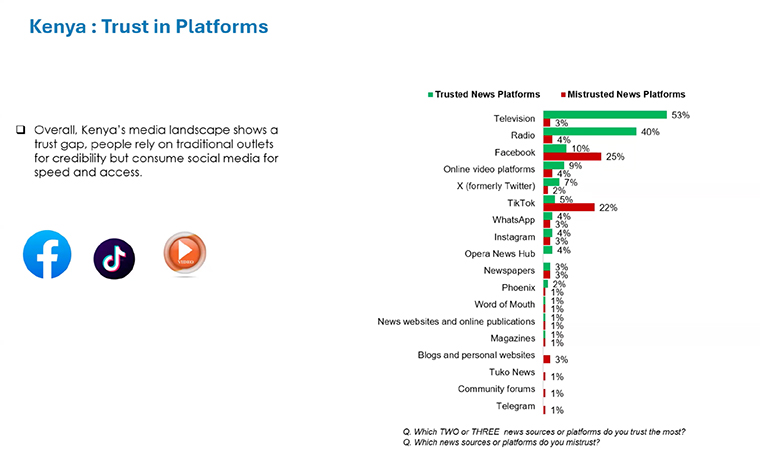
This created different roles for different platforms, Ireri said. Social media can deliver speed, reach, and engagement, while radio and television can offer trust and depth. She also identified credible YouTube channels and other digital video products as an opportunity for news organisations.
Audiences want value
Ireri’s final reality check concerned the assumption that producing more content automatically attracts greater consumption.
An East African study found some respondents were taking breaks from social media because they felt overwhelmed by the volume of available content. Ireri did not disclose detailed figures, citing confidentiality.
“Audiences do not need more content,” Ireri said. “They need content that is worth their attention.”
She urged content producers to prioritise concise, relevant, and compelling work that informs, educates, or entertains. Asked about podcasts in Africa, Ireri said there was room for the format, but podcasts would need to distinguish themselves from the large number of creators producing similar content.
Banner image: Adobe stock image By Quality Stock Arts.
Related Articles
-

5 lessons from the INMA Young Audiences Summit
28 September 2026 -

The 3 editorial pillars of Chile’s first streaming news channel
23 September 2026 -

Nation Media Group focuses editorial strategy on stories that m...
4 August 2026 -

Economist launches subscription tier targeting younger audience...
20 July 2026 -

Grupo RBS builds social-first video operation to expand audienc...
20 July 2026 -

AI adoption in newsrooms should move from experiment to strateg...
12 July 2026 -

27% of people get their news from a creator
6 July 2026 -

Why are audiences going to AI answer engines for news?
30 June 2026
Upcoming Events
-

Subscriber Acquisition Master Class
10-17 November 2026
-

Media Advertising Summit
New York, United States
07-10 December 2026
-

AI-Native News Product Master Class
18-25 February 2027
-

Media Subscriptions Summit
Oslo, Norway
08-12 March 2027
-

World Congress of News Media
New York, United States
25-30 April 2027
-

Branded Content & Partnerships Master Class
20-27 May 2027
-

Subscriber Retention Master Class
17-24 June 2027
-

Conferencia Latinoamericana
15-16 July 2027
-

South Asia News Media Festival
New Delhi, India
19-22 July 2027
-

Asia/Pacific News Media Summit
19-20 August 2027
-

CEO Roundtable at Kilkenny
Kilkenny, Ireland
24-26 August 2027
-

Media Innovation Week
Amsterdam, The Netherlands
27 September - 01 October 2027