

Newsrooms must restructure to adapt to an AI world
Newsroom Innovation Initiative Blog | 21 October 2026





As newsrooms adapt to working with AI, their roles, structures, and mindsets are changing. A recent Newsroom and AI Master Class demonstrated how that is playing out in real-time at organisations worldwide.
Gina Chua, executive editor at Semafor and executive director of the Tow-Knight Center at City University, New York, showed how quickly this shift is unfolding — and why journalists need to rethink their entire operating model.
As a small newsroom without legacy systems, Semafor could test early generative AI tools immediately, building custom GPTs and lightweight assistants. But those experiments lived outside the workflow, meaning reporters had to copy and paste outputs.
“The friction was too high for sustained use,” she said.
The turning point came when Semafor moved its AI work into Google Apps Script inside Google Docs. A suite of tools now sits directly in the newsroom’s daily workflow: multilingual search, related‑story detection, copy editing, style‑guide queries, headline help, and even chart generation. Another system reads all reader e‑mails and surfaces leads, complaints, corrections, and messages from influential people.
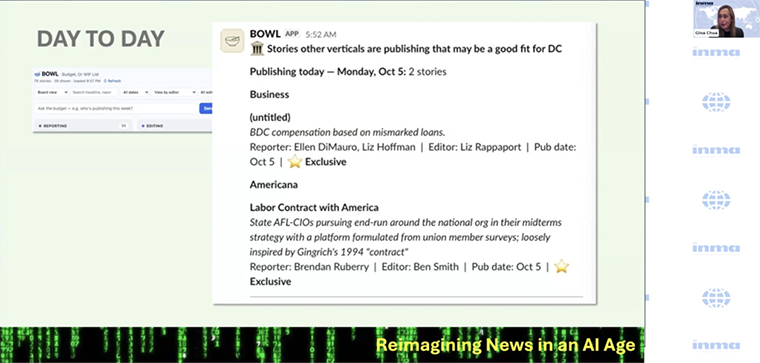
Semafor also built deeper analytical tools. One system ingests hundreds of CEO interview transcripts, breaks them into claims, clusters them, and lets reporters interrogate patterns across topics. Once the backend exists, Chua noted, the newsroom can replicate it for podcasts, events, or any large text corpus.
But the real change is in how they approach the news. Instead of thinking from the bottom up, Chua said newsrooms should think from the top down: Start with what people want, then decide how to serve those needs, and finally what to create.
“It starts with people, and [journalists] are at the tail end of it,” she said. “If it is not informed by what people want to know, we’re going to be writing things that no one wants to read.”
Letting journalists solve problems
Politico is reshaping how journalists adopt AI by letting them build the tools they need.
According to Matilde Baggio, newsroom strategy editor, the approach began as a change‑management effort: Politico found that while large language models were available, many journalists couldn’t see how they applied to their work.
Working groups in the U.S. and Europe met weekly to explore use cases, which led to newsroom‑wide training. But reporters still wanted help connecting AI to their daily tasks, so Politico decided to put the technology directly in their hands.
“What made the difference is the trust that is built through people actually using the tools themselves,” Baggio said.
Hackathons now happen weekly. Each session brings together one newsroom team, several engineers, and a technical coach who guides journalists as they build tools themselves. Reporters submit workflow problems in advance, then spend three hours creating prototypes. A typical session produces two to five working tools.
Since May, more than one in four Politico journalists has built an AI tool, generating over 70 ideas and 23 active prototypes. ChatGPT adoption has climbed from one in seven employees to nearly one in two.
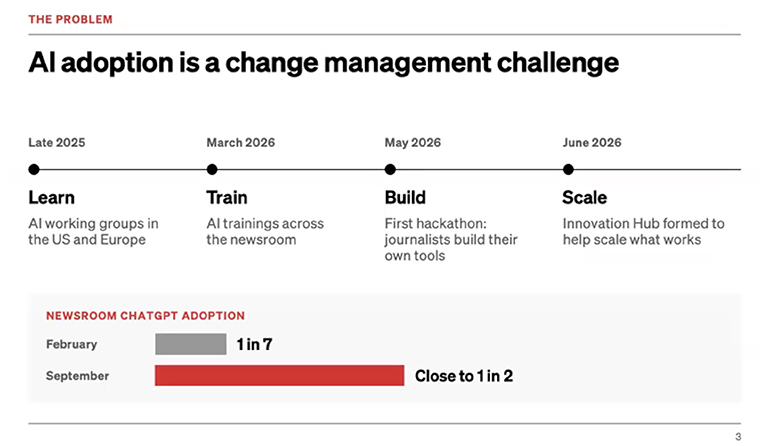
To manage growth, Politico created an Innovation Hub that evaluates whether prototypes should remain personal, be shared through a skills marketplace, or be built into its new CMS. Not every tool must scale, Baggio noted; a prototype that helps one reporter work faster still counts as success.
The core principle is simple: Journalists understand their problems best and are best equipped to solve them.
“Your best tool builders are actually already in your newsroom,” she said. “Your job is just to give them the space and the technical coaches to help develop those tools.”
AI experimentation moves into the newsroom
At Reuters, AI experimentation has gone beyond product and engineering teams and into the hands of its 2,500 journalists. But, as Arlyn Gajilan, global editor for AI development and integration at Thomson Reuters explained, this requires a careful balance of freedom, oversight, and newsroom culture.
At the same time the company is encouraging reporters to build their own tools, they must maintain the editorial standards that underpin Reuters’ Trust Principles.
The fifth principle, she explained, calls for the company to continually expand, develop, and adapt its news services and products. AI aligns with Reuters’ long tradition of technological innovation, Gajilan said, tracing its innovation from carrier pigeons delivering financial data to telegraph investments that helped the company break major news.
Today, Reuters gives journalists access to frontier models and OpenArena, an internal environment for building AI‑powered workflows. Reporters can connect government data feeds to large language models or prototype tools during internal hackathons. Some have even learned Python to create more advanced applications.
The goal is to eliminate the bottleneck where journalists wait months for engineering support: “Let’s let people build,” Gajilan said.
Reuters’ approach rests on a principle that AI won’t change: “We, the journalists, are responsible for what we publish,” Gajilan said.
To ensure safety and reliability, Reuters established a tiered governance system. Personal experiments can run independently, but once a tool proves useful to others, it undergoes frontline review for security, coding standards, and scalability.
Tools that become part of core workflows or the CMS face deeper scrutiny from an AI governance committee led by the editor‑in‑chief. Reuters also distinguishes between incidental AI use, foundational AI use, and the large middle category where AI assists but does not replace editorial judgment.
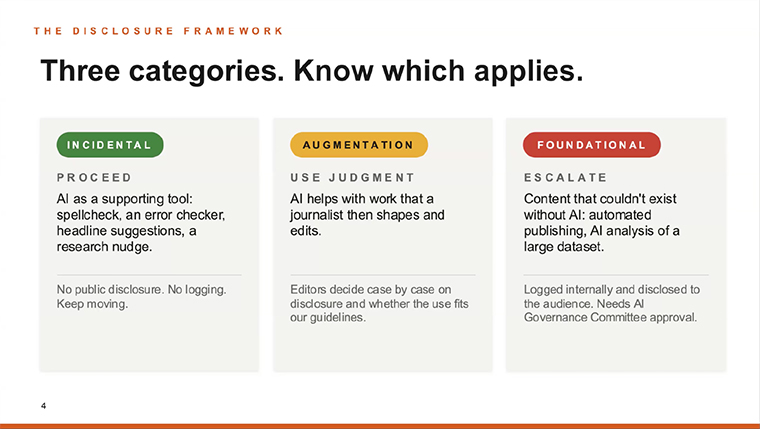
Training is essential. About 85% of Reuters’ 400 managers and editors have completed AI training, with mandatory staff‑wide training underway. But Gajilan emphasised that culture matters most: Journalists must feel safe disclosing how they use AI. If experimentation goes underground, she warned, “governance becomes absolutely impossible.”
Finding an audience that never existed
Young audiences aren’t “leaving” news publishers — most never showed up in the first place.
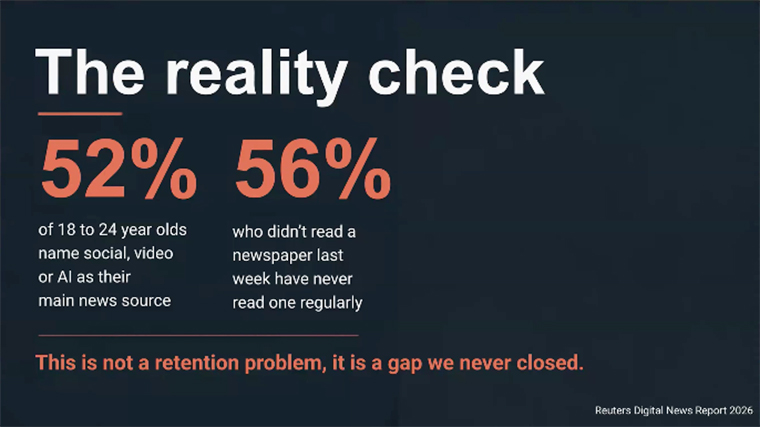
That was the central message from Kerstin Hasse, INMA’s Young Audiences Initiative lead, who pointed to two striking data points:
- 52% of 18- to 24-year-olds get news primarily from social, video, or AI.
- 56% of those who didn’t read a newspaper last week have never been regular readers at all.
“This is not a retention problem. This is a big gap that we never closed in the first place,” Hasse said.
Hasse outlined three actions publishers must take to reach these audiences: show up, build for them, and charge differently.
Showing up means treating youth-oriented platforms as habitats, not distribution channels. She highlighted Spilnews, a creator‑economy newsroom Mediahuis built separately from its legacy operations.
Journalists act as editorial creators while external creators handle partnerships, and the platform operates natively without relying on external algorithms. Audience research drives content decisions, and brand partnerships can exceed €100,000.
Building for young audiences requires adapting products to their consumption habits. Hasse pointed to 20 Minuten’s pivot from print to vertical video stories that mimic TikTok and YouTube feeds. Editors fact-check every video and pair it with a full written story. The format blends entertainment, daily news, and lifestyle content in a “snackable” experience that feels familiar to younger users.
Ultimately, she said, the barrier isn’t young people — it’s newsroom culture.
“What is important regarding strategies to reach young audiences is to find people who feel your news brand, asking them questions, giving them responsibilities, and listening to them,” she said.
“If you’re in a managing position and you don’t want to spend time on these platforms that shape the habit of how young people consume news, then at least make sure you talk to young people who can explain to you what it is all about.”
Thriving in the age of content
Modern newsrooms look, operate, and make money very differently than traditional advertising models, largely because of consumer demand.
As Greg Piechota, researcher-in-residence and INMA Readers First Initiative lead, shared: “Today, most news is funded by consumers. This is bigger than just a revenue model change. This is a paradigm change.”
Piechota emphasised that journalism is not interchangeable with content. He compared raw information to raw eggs: You can consume it, but it’s unsafe. Journalism is the process that makes information reliable — witnessing events, verifying facts, investigating what’s hidden, and making sense of it for audiences.
That process is what consumers pay for, not the “content” itself.
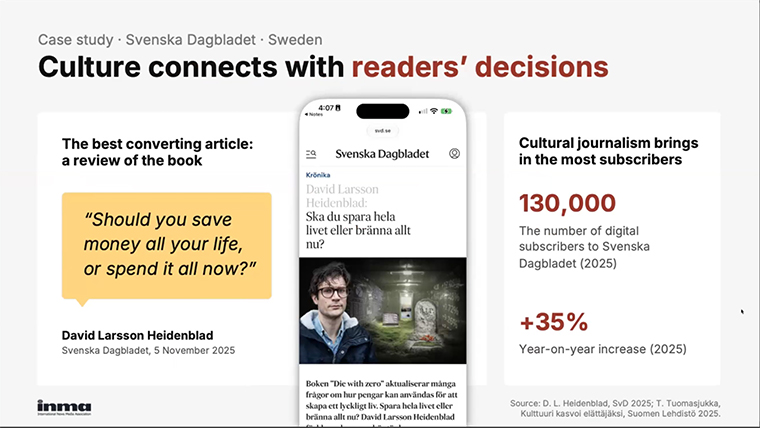
He pointed to Svenska Dagbladet as a case study in understanding value. The Swedish newspaper found that cultural journalism — especially book reviews — drove a 30% year‑over‑year subscription increase.
As Editor‑in‑Chief Lisa Irenius told him, cultural coverage helps readers make meaningful life decisions, creating “aha moments” that deepen loyalty. Piechota suggested subscriber‑first newsrooms should intentionally track these moments rather than rely solely on traditional engagement metrics.
Diversification is another pillar of consumer‑driven journalism. With unlimited content available — including AI‑generated material — publishers must offer distinctive experiences. He highlighted HistoryExtra, which produces long‑form historical video, audio, and print.
“If you start with the richest format, it’s actually much easier to produce those derivatives,” he noted.
Though AI can summarise long-form video, it cannot replicate the kind of detail and human interaction this type of video series aimed to capture.
Piechota also urged publishers to give audiences more reasons to visit beyond news alone. Games, trivia, and lifestyle verticals on fitness, money, or health can boost engagement and reduce churn.
He closed with three principles for building a subscriber‑first newsroom: Define your value proposition, meet people’s needs, and make the change permanent through empowered teams and clear decision‑making.
Banner art: Adobe stock image by Long.
Related Articles
-

Marketers should outsource tasks, not thinking
25 October 2026 -

AI’s effect on super user math
15 September 2026 -

At Mediacorp’s CNA, loyalty means giving audiences a reason to ...
20 August 2026 -

Tribun Network turns print “dots” into AI-powered insight
20 August 2026 -

Nation Media Group focuses editorial strategy on stories that m...
4 August 2026 -

Briefly News empowers journalists with AI tool suite Nova
4 August 2026 -

Indian Express builds a video-first future around trusted journ...
20 July 2026 -

Economist launches subscription tier targeting younger audience...
20 July 2026
Upcoming Events
-

Subscriber Acquisition Master Class
10-17 November 2026
-

Media Advertising Summit
New York, United States
07-10 December 2026
-

AI-Native News Product Master Class
18-25 February 2027
-

Media Subscriptions Summit
Oslo, Norway
08-12 March 2027
-

World Congress of News Media
New York, United States
25-30 April 2027
-

Branded Content & Partnerships Master Class
20-27 May 2027
-

Subscriber Retention Master Class
17-24 June 2027
-

Conferencia Latinoamericana
15-16 July 2027
-

South Asia News Media Festival
New Delhi, India
19-22 July 2027
-

Asia/Pacific News Media Summit
19-20 August 2027
-

CEO Roundtable at Kilkenny
Kilkenny, Ireland
24-26 August 2027
-

Media Innovation Week
Amsterdam, The Netherlands
27 September - 01 October 2027