

Why publishers are doing less, but better, to win in the AI era
Newsroom Innovation Initiative Blog | 22 October 2026




As AI reshapes how audiences find news, news publishers are increasingly betting on depth, distinctiveness, and newsroom expertise over volume — a theme that ran through the recent INMA Newsroom and AI Master Class.
Sonali Verma, lead of the INMA Newsroom Innovation Initiative, moderated the event and presented four very different strategies from around the world.
When fewer is better
The Times and The Sunday Times have embraced a “fewer, better stories” strategy that reduces daily output while improving engagement and overall performance, explained Anna Sbuttoni, deputy head of digital.
Three years ago, a detailed content review revealed that one‑fifth of articles attracted very few subscriber reads, leading the newsroom to cut its daily volume from more than 200 stories to about 170.
“I just want to be really clear that this has not been about cutting resources,” Sbuttoni said. “This is about producing less but making everything we produce better, and also making sure that it lands with impact.”
Editors shifted focus toward original reporting, live coverage, visual storytelling, and journalism that subscribers consider worth paying for. Sbuttoni explained the newsroom found it could eliminate roughly a quarter of its stories while still retaining about 95% of pageviews.
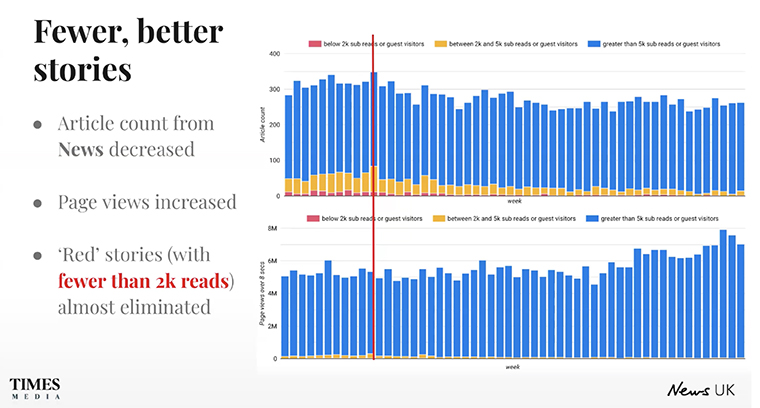
The results have been striking:
- Traffic increased across key desks even as output declined, with similar gains in sport, business, and world coverage.
- The newspaper replaced incremental updates that added little depth with more substantial, impactful pieces.
- Visual‑led stories now generate about four‑and‑a‑half times the engagement of standard articles, and a redesigned live‑blog format has strengthened real‑time coverage.
Despite an industry-wide decline in traffic, The Times recorded four consecutive months of record audience growth and continued to see year-on-year growth. However, Sbuttoni said traffic alone cannot sustain the business; the publisher must engage and retain both new and existing subscribers.
Innovating with video
For newsrooms investing in video, producing more content may seem like the obvious way to reach more viewers. But at the South China Morning Post (SCMP), the strategy is built around a different question: How can a newsroom make the greatest impact with the resources it has?
“We shouldn’t be trying to compete with them in terms of volume,” said Chieu Luu, director of video at SCMP, referring to larger news organisations with far greater production capacity.
Instead, SCMP concentrates on the journalism audiences most associate with the brand: Hong Kong, mainland China, and Asia. “We go deeper,” Luu said, referring to the newsroom’s emphasis on context, nuance, and distinctive storytelling.
Analytics have helped SCMP identify three high‑performing video categories: breaking news clips, evergreen explainers, and character‑driven documentaries.
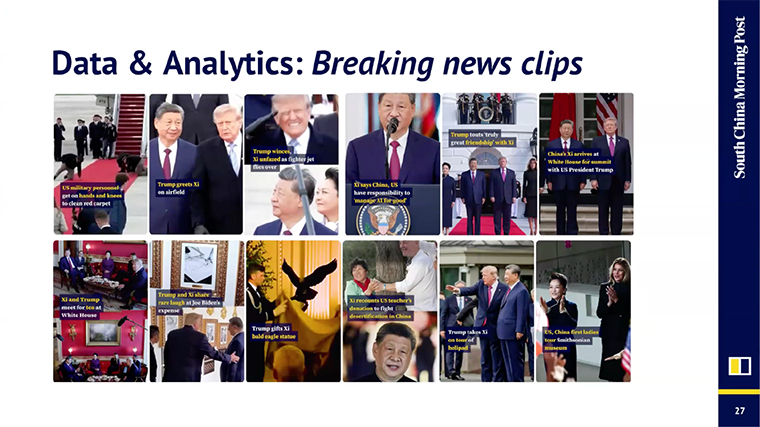
Breaking news provides rapid visual updates across social platforms; explainers such as the SCMP Explained series offer long‑tail value and can be embedded across multiple articles; and documentaries produced through SCMP Films humanise major social issues and showcase the newsroom’s reporting strength.
Reporter‑fronted videos have also proved effective, helping SCMP compete with creators and influencers in social feeds.
This approach has delivered strong results. Individual videos routinely reach millions of viewers on platforms like Instagram and Facebook, and longer explainers and documentaries perform well on YouTube, especially when picked up by YouTube TV’s algorithm.
But Luu reminded everyone that no video strategy can compensate for weak reporting: “None of this would be successful if we didn’t do good journalism,” he said.
AI-native products
The San Francisco Standard has spent the past year building one of the industry’s first truly AI‑native news experiences.
With a US$150,000 Lenfest Institute grant, Editor‑in‑Chief Kevin Delaney partnered with Bit Bit Press to create a fully AI‑powered CMS — “like if WordPress was built today and not 20 years ago.”
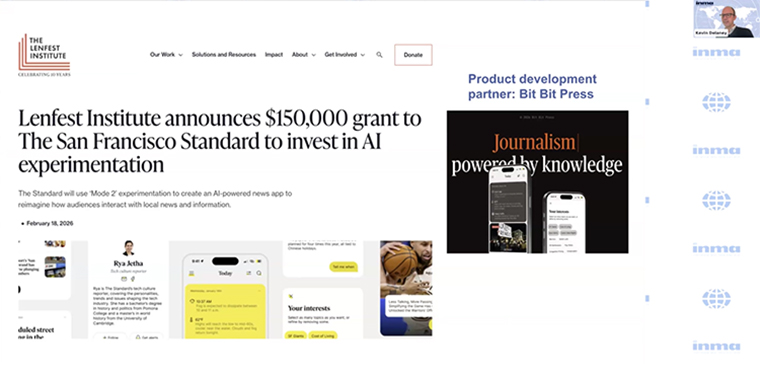
The CMS allowed editors to use prompts to create new product features and break articles into smaller, atomised pieces of content. And no time was wasted: The grant arrived January 20, and The Standard launched a live app for subscribers by April 20.
At the core is a large‑language‑model profile for each user that actively learns their interests and reshapes their feed. Readers can type anything — from “burritos in the Mission District” to “swimming in the San Francisco Bay” — and the app adjusts accordingly.
AI generates personalised briefings, creates question‑and‑answer modules, identifies people mentioned in stories, produces pull quotes, builds polls, and maps locations referenced in articles. These features extend reporting in ways a small newsroom could never do manually.
Early results show significantly higher engagement, strong app‑store ratings, and overwhelmingly positive user feedback on AI‑generated content. While it’s too soon to measure retention, Delaney said the experiment positions the newsroom for the next five years — building journalism where AI is woven directly into how stories are structured, personalised, and delivered.
Journalism as intelligence
The future of AI in newsrooms isn’t about producing more content — it’s about transforming journalism into a form of intelligence.
That’s the word from Francesco Marconi, co‑founder of Applied XL, who told the audience that AI’s real value lies in scaling core journalistic behaviours: observing change, identifying meaningful signals, verifying facts, and connecting disparate information.
But he emphasised that data alone isn’t a differentiator. What really matters is the newsroom’s “proprietary observation” — the human expertise that recognises what’s important, why it matters, and how it fits into a broader system.

To further demonstrate the importance of the knowledge within any given newsroom, Marconi used the example of coverage of data centres: multiple newsrooms may access the same public records, yet only a reporter with deep domain knowledge can interpret revisions, estimate resource needs, or understand stakeholder dynamics.
He calls this human‑driven pattern recognition the “human algorithm,” something AI cannot replicate without editorial guidance.
To systemise this intelligence, Marconi proposes codifying beats into finite sets of observable events, data sources, and relationships — what he calls “domain ontology.” AI can then monitor these signals at scale, flag changes, and categorise developments, while journalists verify and contextualise them.
Ultimately, Marconi believes the future of news still remains in the newsrooms: “Newsrooms can become specialists at proprietary observation, and that proprietary observation becomes the basis for a lot of the systems that we use for news gathering and covering different topics.”
Newsrooms with tools and workflows that systematise news gathering can better optimise their output and deliver information to consumers in ways that set them apart from competitors.
Banner art: Adobe stock image by Pakin.
Related Articles
-

Marketers should outsource tasks, not thinking
25 October 2026 -

AI’s effect on super user math
15 September 2026 -

VG turned AI video into discovery engine for premium content
14 September 2026 -

At Mediacorp’s CNA, loyalty means giving audiences a reason to ...
20 August 2026 -

Tribun Network turns print “dots” into AI-powered insight
20 August 2026 -

Nation Media Group focuses editorial strategy on stories that m...
4 August 2026 -

Briefly News empowers journalists with AI tool suite Nova
4 August 2026 -

Indian Express builds a video-first future around trusted journ...
20 July 2026
Upcoming Events
-

Subscriber Acquisition Master Class
10-17 November 2026
-

Media Advertising Summit
New York, United States
07-10 December 2026
-

AI-Native News Product Master Class
18-25 February 2027
-

Media Subscriptions Summit
Oslo, Norway
08-12 March 2027
-

World Congress of News Media
New York, United States
25-30 April 2027
-

Branded Content & Partnerships Master Class
20-27 May 2027
-

Subscriber Retention Master Class
17-24 June 2027
-

Conferencia Latinoamericana
15-16 July 2027
-

South Asia News Media Festival
New Delhi, India
19-22 July 2027
-

Asia/Pacific News Media Summit
19-20 August 2027
-

CEO Roundtable at Kilkenny
Kilkenny, Ireland
24-26 August 2027
-

Media Innovation Week
Amsterdam, The Netherlands
27 September - 01 October 2027