

When intelligence becomes cheap for consumers, what remains scarce?
Product & Tech Initiative Blog | 29 September 2026

I had a fascinating conversation recently about the economics of frontier AI. One argument was that we may be looking at the economics slightly incorrectly.
Training frontier models costs extraordinary amounts of money. But once a model exists, many everyday uses of it can be relatively efficient. Simple inference (e.g., answer this question, summarise this document) is very different economically from asking an agent to conduct 20 minutes of research across dozens of sources. Meanwhile, the companies keep spending because they’re building the next generation.
What interested me more, though, was what happens over time. Technology follows a familiar pattern: Something starts scarce, expensive, and difficult. Infrastructure improves, competition increases, and costs fall. Eventually, yesterday’s premium capability becomes tomorrow’s commodity.
AI seems to be moving through this cycle extraordinarily quickly. Think about image generation, transcription, translation, or coding. Things that felt like astonishing differentiators very recently are becoming expected features.
Which raises an uncomfortable question for everyone building on AI: How long is your moat?
The moat of scarcity
There are clearly enormous opportunities over the next one to three years. Agencies can build sophisticated agents, software companies can create specialised workflows, and publishers can build products around proprietary information and expertise. But we need to distinguish a temporary capability advantage from a durable strategic advantage.
Models will catch up. Open-source and open-weight alternatives will improve. Agents will become easier to create. Features will be copied. Even proprietary information may not be quite the moat we imagine as models become increasingly good at searching the Web, interrogating databases, and researching specialist subjects.
That doesn’t make expertise irrelevant, but it may change where its value sits. So what remains genuinely scarce?
I keep coming back to four things: context, trust, permission, and relationships.
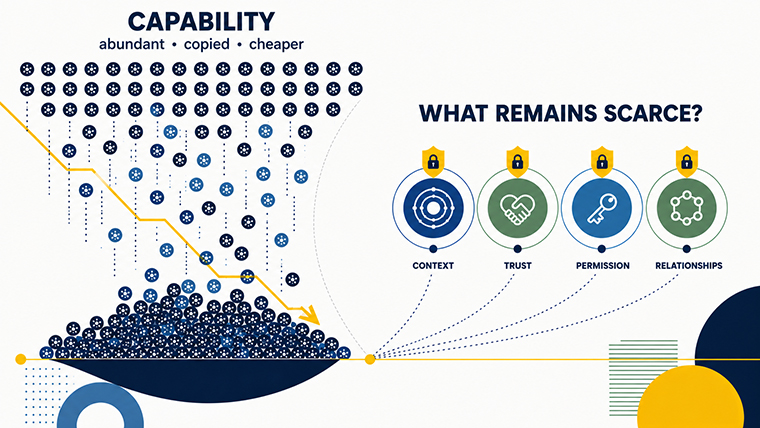
Knowing the generic answer to a question is becoming cheap. Knowing the right answer for me is different. My preferences, history, relationships (especially relationships), goals, subscriptions, calendar, work, purchases, and the sources I trust all make intelligence exponentially more useful.
Then there is permission. People aren’t going to put their entire lives into a public database, but we may give trusted AI systems access to parts of our lives because the benefit is worth it.
Information can be copied and capabilities can be replicated. My permission to use information on my behalf cannot.
And I suspect that is where one of the next great competitive battles in AI is beginning.
Personal context may be the next great moat
There is one enormous dataset that isn’t becoming public: me, an individual — multiplied by several billion variants known as other humans.
My e-mail, calendar, photographs, search history, purchases, reading, subscriptions, travel, family, and work. Potentially my finances and health, too. This is why I think personal context may become one of the most valuable layers in AI.
Google just gave us an interesting glimpse of this with Expert Intelligence. The first implementation sounds relatively simple: You can bring eligible books you’ve purchased into Gemini Notebook and combine their expertise with your own information.
And then Apple made personal context through on-device Apple Intelligence, keeping your data local to your device. Privacy has become core to their product promise.
Just before the deadline of this newsletter, Meta launched Muse – a truly personal chatbot/agent that has been widely reported to give an impressive consumer experience.
Now look at what this all actually means. The value isn’t simply the book, and it isn’t Gemini. Nor is it the phone or the Mac. Or connecting apps. It is information and knowledge + my personal context + my permission to bring them together.
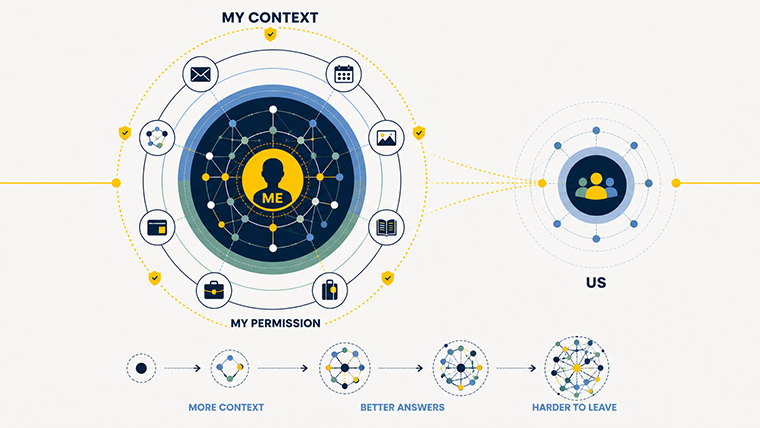
Google has an extraordinary starting position here. Its Personal Intelligence features can connect, with permission, information across services including Gmail, Photos, Search, and YouTube. Ditto with Apple as it can access all the apps already downloaded onto your device.
That makes the competition between the established consumer tech companies and OpenAI particularly interesting. And it shows that a great product from Meta suddenly supercharges it back into the race.
All are plausible candidates to become the front end for personal AI, but they come at it from different directions.
- Google and Apple potentially know an extraordinary amount about what I’ve done, what my interests are, and who my friends are.
- OpenAI has spent the past few years building the AI relationship itself: People tell ChatGPT what they’re working on, ask it for advice, think through decisions with it, and give it context explicitly because doing so makes the answers better. OpenAI may therefore increasingly understand what I’m trying to do.
Different starting points, similar destination: an AI that doesn’t simply know the world — it knows me.
There is a parallel battle inside companies. Anthropic has made enterprise a particularly important part of its strategy, connecting Claude to organisational documents, systems, code, and workflows. OpenAI is competing hard here, too, through APIs. Apple is doing so through on device apps. Google will be part of this, and others will emerge.
For enterprises, the prize is not just model usage. It is understanding the organisation: its knowledge, systems, processes, and ways of working. So perhaps there are two context battles happening simultaneously: who understands me and who understands us?
Context has another important characteristic: its value compounds. If my AI knows my children’s ages, where we’ve travelled before, which hotels I liked, my flight details, and what I tend to spend, “Find me a hotel” becomes a much more useful request. Every additional piece of context improves the next answer.
That also creates a cost of switching. If another model becomes marginally smarter next month, do I move if my existing AI understands years of my life? Probably not.
Which is why the most important moat in AI may ultimately have surprisingly little to do with the model. Models can catch up. Context is sticky. And permission makes it stickier still.
If you’d like to subscribe to my bi-weekly newsletter, INMA members can do so here.
Banner photo: Adobe stock image by MdSuhel.
Related Articles
-

6 lessons from INMA’s Media Tech & AI Conference
29 October 2026 -

AI’s effect on super user math
15 September 2026 -

The front door is gone — and Asia-Pacific publishers are rebuil...
26 August 2026 -

At Mediacorp’s CNA, loyalty means giving audiences a reason to ...
20 August 2026 -

BusinessDay moves from business content to business intelligenc...
6 August 2026 -

JioStar’s sports playbook shows news publishers how to build au...
22 July 2026 -

The reality check of user needs: “Update me” drives most demand...
13 July 2026 -

Why are audiences going to AI answer engines for news?
30 June 2026
Upcoming Events
-

Subscriber Acquisition Master Class
10-17 November 2026
-

Media Advertising Summit
New York, United States
07-10 December 2026
-

AI-Native News Product Master Class
18-25 February 2027
-

Media Subscriptions Summit
Oslo, Norway
08-12 March 2027
-

World Congress of News Media
New York, United States
25-30 April 2027
-

Branded Content & Partnerships Master Class
20-27 May 2027
-

Subscriber Retention Master Class
17-24 June 2027
-

Conferencia Latinoamericana
15-16 July 2027
-

South Asia News Media Festival
New Delhi, India
19-22 July 2027
-

Asia/Pacific News Media Summit
19-20 August 2027
-

CEO Roundtable at Kilkenny
Kilkenny, Ireland
24-26 August 2027
-

Media Innovation Week
Amsterdam, The Netherlands
27 September - 01 October 2027