
Publishers rewrite the advertising playbook as traffic declines and AI reshapes monetisation
World Congress Blog | 14 May 2026

Advertising executives and media leaders delivered a blunt assessment of the publisher revenue model at the INMA World Congress of News Media in Berlin last week: The era of relying on scale, referral traffic, and standard display advertising is ending.
Across conference sessions, seminars, and study tour discussions, executives described a new advertising playbook built around first-party data, video storytelling, branded partnerships, events, retail media, premium communities, and AI-enabled infrastructure designed to preserve publisher control as traffic declines and platform dependence deepens.
The strongest throughline of the week came from sessions led by INMA Advertising Initiative Lead Gabriel Dorosz, whose conference panel and Friday advertising seminar focused on the industry’s shift away from inventory-based thinking toward commercial ecosystems built around audience relationships and premium experiences.
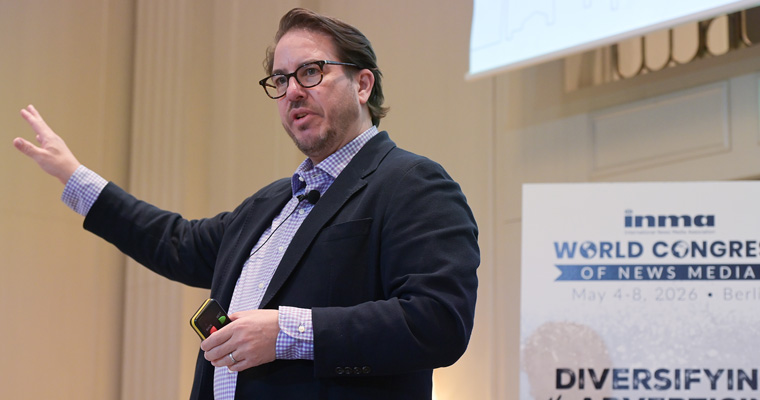
“Advertising is no longer a scale game,” Dorosz said during the conference session on rebuilding advertising around audience value.
Referral traffic decline is forcing a reset
Executives throughout the week described an industry under pressure from declining search and social traffic, weaker display advertising performance, browser privacy restrictions, and AI systems that reduce clicks while extracting value from publisher content.
News publishers are already seeing the consequences of falling traffic volumes, Dorosz said: “We now have a thousand studies on traffic. They all say traffic’s down, and it’s going to keep going down.”
The Friday advertising seminar framed the challenge directly in its opening description: “Traffic is declining; display alone won’t work.”
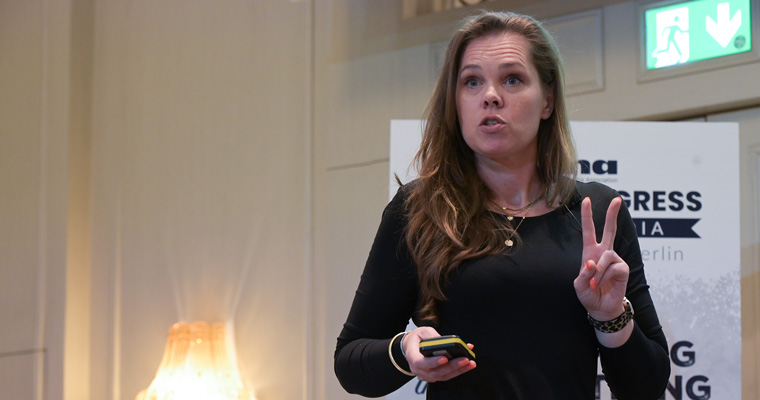
Meanwhile, Mediahuis B2B Strategy Director Kitty Brouwer discussed how publishers must prepare for multiple commercial futures as audiences move across AI interfaces, platforms, and distributed environments.
Her presentation focused less on predicting a single outcome and more on helping publishers identify the capabilities needed to remain commercially relevant as news consumption fragments further across ecosystems.
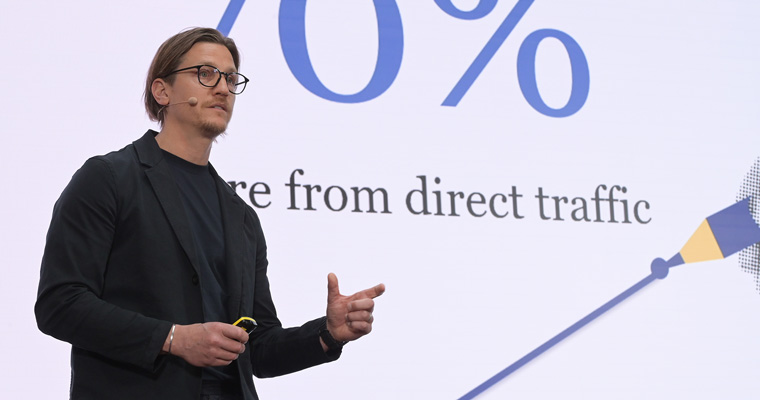
Several executives said direct audience relationships — not raw traffic volume — are becoming the industry’s most important commercial asset.
At Bonnier News, COO Alexander Lydecker explained that the company reorganised its advertising and subscription operations into a single strategy focused on moving audiences from anonymous reach toward registered and logged-in relationships.
Before the reorganisation, advertising and subscriptions operated separately. Now, Lydecker said, “everything is built in what we call the front engine.”
He described logged-in users not only as better subscription prospects but also as a more valuable advertising product because first-party data enables higher pricing and stronger targeting capabilities. Bonnier executives said the company has already seen significant pricing uplift from those audience relationships.
That integration between advertising, subscriptions, editorial, and product teams became one of the dominant strategic themes of the week.
Dorosz said publishers cannot succeed in newer formats like premium video if advertising is treated as an afterthought.
“None of this is possible if advertising shows up after the product is built,” he said.
Video, events, and partnerships are becoming core products
Executives repeatedly pointed to video, events, branded content and partnerships as critical growth areas as traditional display revenue weakens.
Dorosz highlighted examples including The Atlantic, where events now represent roughly a quarter of commercial revenue, and Semafor, where events account for more than half of revenue.
But speakers also noted that those businesses require different skills and organisational structures than traditional advertising sales.
“Events are hard to manage and scale,” Dorosz said.
Several study tour stops reinforced how publishers are increasingly building premium commercial products around specialised communities and professional audiences.
Publishers discussed how events and physical experiences are increasingly tied to membership and sponsorship strategies. During the Berlin study tours, executives pointed to Pioneer and its events and riverboat gatherings for political and business elites as an example of how media brands are creating experiential businesses around their journalism.
Several presentations showed how publishers are increasingly positioning themselves less as inventory sellers and more as strategic marketing partners.
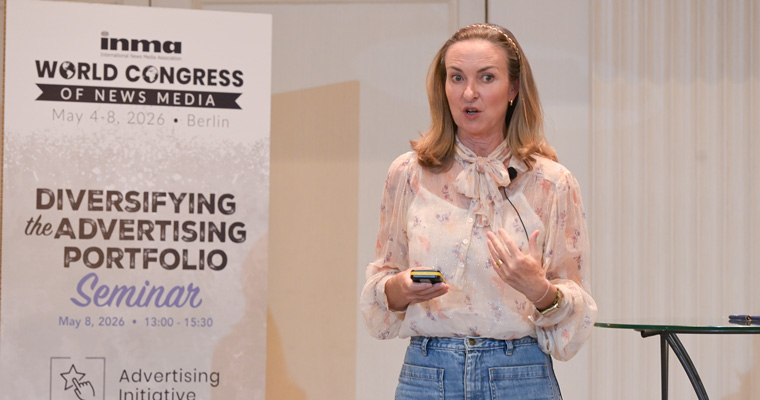
At News Corp Australia, Managing Director and Publisher for Free News and Lifestyle Pippa Leary discussed how publishers are using first-party data and shifting newsroom workflows toward visual storytelling formats designed for video-led and off-platform consumption. She said working with first-party data is now “much more accessible than it’s ever been before.”
Her presentation focused on helping publishers build commercial products around audience engagement rather than commodity inventory. She also discussed the need to expand visual storytelling capabilities across organisations rather than isolating them inside specialised teams.
During another seminar discussion, Dorosz raised questions about whether publishers may need to move further away from programmatic advertising and closer toward partnership-led commercial models tied to creators, communities, and younger audiences.
Retail media and AI infrastructure are opening new revenue paths
AI shaped nearly every advertising discussion during the week.
Executives discussed not only how AI threatens referral traffic, but also how it may change how advertising is bought, sold, targeted, and measured.
At the advertising seminar, IAB Tech Lab EVP Product and COO Shailley Singh said publishers are already losing substantial advertising value because of browser privacy changes and AI-driven search behaviour.
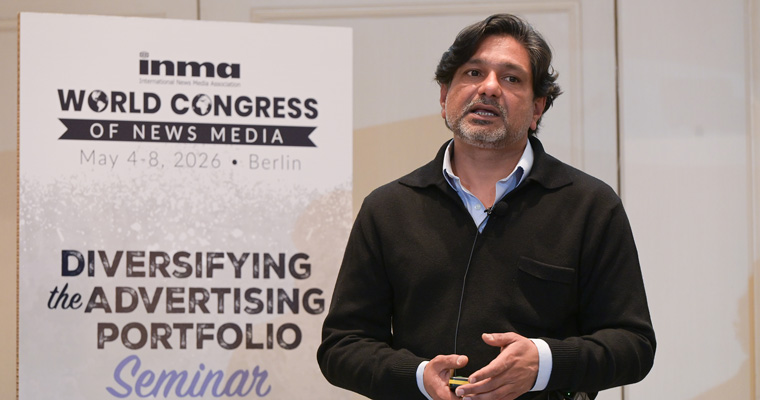
“It was pretty clear that we’re losing 30% to 50% of the addressable inventory,” Singh said while discussing browser restrictions and data loss.
Singh described growing efforts to rebuild monetisation infrastructure around publisher-controlled environments rather than browser-based third-party systems. He also outlined emerging standards intended to help publishers track, license, and potentially monetise AI usage of their content through structured APIs and agentic transaction systems.
Publishers also discussed how commerce and retail data are becoming part of the next advertising stack.
At Bonnier News, Sales Director Paul Brandenfeldt described the company’s expansion into retail media and in-store advertising partnerships designed to connect audience data with purchasing behaviour.
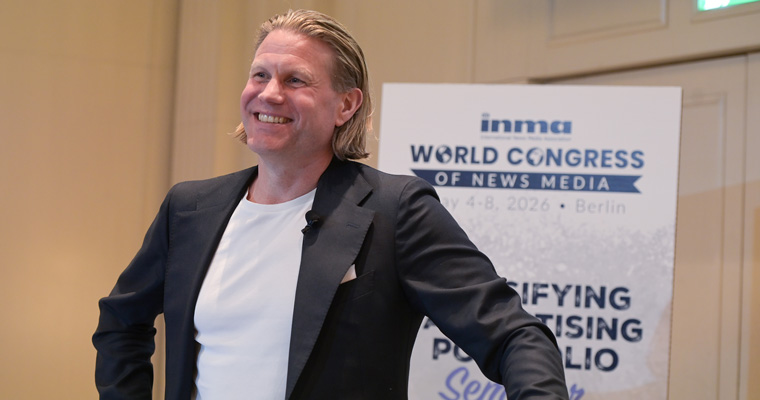
The presentation outlined how publishers are increasingly layering commerce and retail technology onto trusted media brands to diversify beyond traditional advertising inventory.
A new publisher model is emerging
By the end of the World Congress week, a clearer picture had emerged of where many publishers believe advertising is heading.
The model described in Berlin was less dependent on pageviews, standard display inventory, and platform referral traffic. In its place, executives outlined businesses built around trusted audience relationships, logged-in ecosystems, premium video, branded storytelling, events, memberships, commerce partnerships, retail media, and AI-enabled infrastructure.
Publishers also increasingly portrayed advertising not as a separate monetisation layer but as something embedded directly into product, audience, and editorial strategy.
The organisations presented as leaders during the week were not necessarily those generating the most traffic. They were the ones building stronger audience identity systems, deeper engagement products, and more diversified commercial businesses.
All photos by Robert Downs Photography.
Related Articles
-

In moving from an attention to an intention economy, who gets p...
16 September 2026 -

What’s really defensible in the age of AI?
30 August 2026 -

Time is now selling ads to AI bots
17 August 2026 -

Latin American publishers must rewrite ad strategies around out...
20 July 2026 -

Platforms took the Croisette in Cannes, and the ad business is ...
6 July 2026 -

Newsday shares its advertising transformation journey
29 April 2026 -

Lessons from case studies in revenue diversification at news co...
30 March 2026 -

Schibsted’s Partnerstudio embraces AI transformation
4 March 2026
Upcoming Events
-

Subscriber Acquisition Master Class
10-17 November 2026
-

Media Advertising Summit
New York, United States
07-10 December 2026
-

AI-Native News Product Master Class
18-25 February 2027
-

Media Subscriptions Summit
Oslo, Norway
08-12 March 2027
-

World Congress of News Media
New York, United States
25-30 April 2027
-

Branded Content & Partnerships Master Class
20-27 May 2027
-

Subscriber Retention Master Class
17-24 June 2027
-

Conferencia Latinoamericana
15-16 July 2027
-

South Asia News Media Festival
New Delhi, India
19-22 July 2027
-

Asia/Pacific News Media Summit
19-20 August 2027
-

CEO Roundtable at Kilkenny
Kilkenny, Ireland
24-26 August 2027
-

Media Innovation Week
Amsterdam, The Netherlands
27 September - 01 October 2027