
Scaling AI tools means scaling support at Sanoma Media
Newsroom Innovation Initiative Blog | 11 October 2026

How do you turn AI pilots into widespread AI adoption in the newsroom? Heidi Iivonen from Sanoma Media Finlandgave us absolutely gold standard tips to ensure the effort is fruitful.
Her key message: Scaling AI tools means scaling support around them. “We believe this is the only way to make AI production last,” she said. “This was a huge job.”
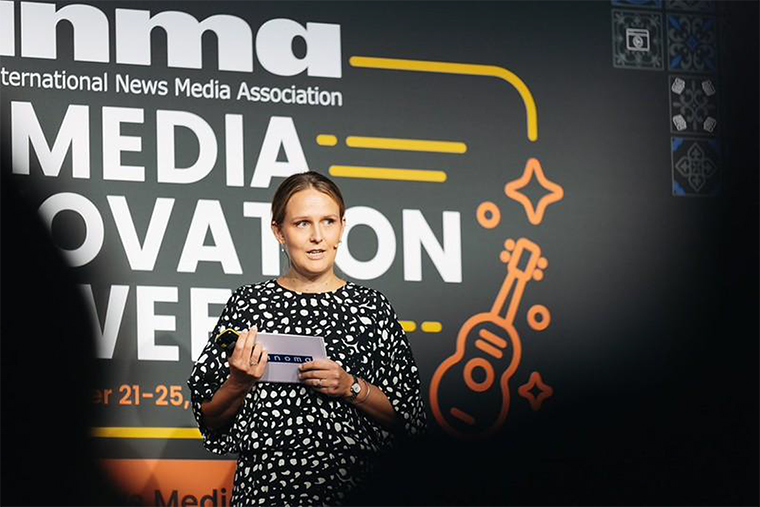
Sanoma started by asking journalists: What makes your work difficult? The question was not “how can AI help you?” because people may not know the answer, she pointed out.
This process led to a list of 74 problems and bottlenecks the newsroom teams then prioritised for resolution as pilot projects. Sanoma quickly learned that off-the-shelf solutions needed to be tailored for specific uses, and what works for one editorial team may not work for another.
When scaling, they decided to launch an intensive two-week support programme for each team, run by a core group of three full-time AI coaches and three developers.
One key part of this was supporting the editorial manager in the rollout “because we knew that our managers have to run the newsroom and lead change at the same time, and people are super busy. So, we gave them an extra pair of hands, and that was the AI coach’s role. So together, the manager and AI coach … instructed people on what they should do. They made sure that everybody who was involved, and they also had critical conversations with people, and also inspired people.”
They kicked off each team’s training with cinnamon rolls (a rare treat!) and group sessions on AI ethics and how LLMs work. They held daily meetings in which each team member shared their learnings and also a Slack channel.
Then each journalist got three hours of side-by-side coaching, she said.
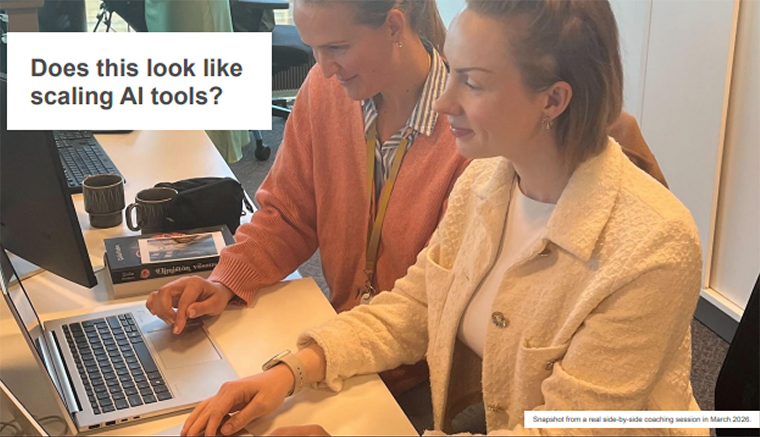
In the photograph above, “we sat there for three hours trying to figure out together how AI could help her in her role, in her tasks, and in her workload. And we did this with hundreds of journalists and spent hundreds of hours,” Iivonen said.
“I know this might not look like scaling AI tools. You might think about a conference room or a room full of people, one person teaching, another person learning. But we did it one person at the time, and I think this was the most important part of our implementation.”
During training, journalists used the tools for real work and offered constant feedback and tips for improvement, which meant they were invested in the tools’ success.
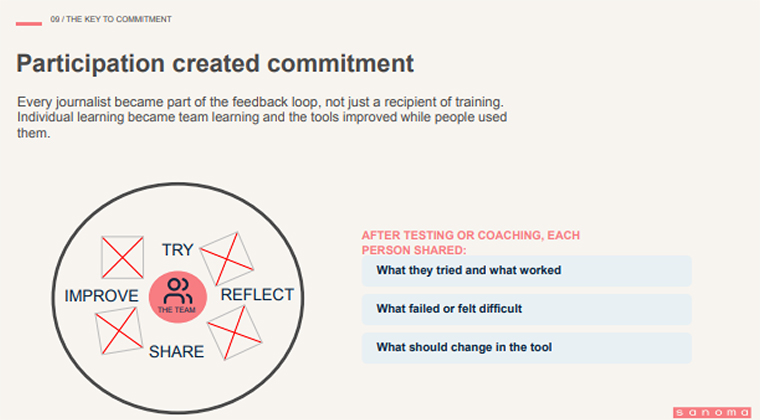
“This is how individual learning became team learning. People shared their findings. People improved the tools with us, and they were not just handed over something,” Iivonen said
The real test began after intensive support ended and journalists went back to their regular routines, Iivonen said. The AI group sent a survey seeking feedback, and managers also checked in with their teams.
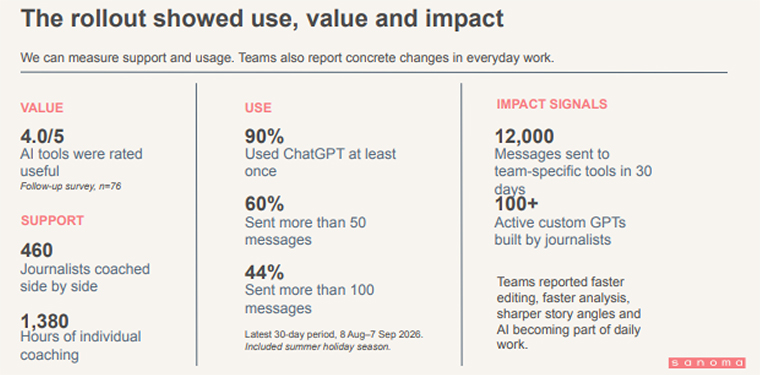
The results showed the newsroom was using the tools and found them genuinely useful.
Naturally, Iivonen encountered skeptics as well.
“They told us that they don’t think AI could help them. They think that it’s totally useless. And with those people, we still have three-hour side-by-side coaching, and it started with the work.
“We asked: What kind of ideas do you have on your list? How are you going to do those articles? Do you have a plan? Do you have an interviewee? And then, when I found out that it was difficult to find an interviewee for their story, I knew that here is the thing you are going to try, and yes, we started with small things with people who were super afraid.”
It helped that Iivonen was a journalist for 17 years. “I know how people are doing their job and what their questions were and their concerns. So AI skills mattered, but the trust and listening mattered just as much.”
If you’d like to subscribe to my bi-weekly newsletter, INMA members can do so here.
Banner photo: Adobe stock image by CuteBee.
Related Articles
-

Marketers should outsource tasks, not thinking
25 October 2026 -

AI’s effect on super user math
15 September 2026 -

At Mediacorp’s CNA, loyalty means giving audiences a reason to ...
20 August 2026 -

Tribun Network turns print “dots” into AI-powered insight
20 August 2026 -

Nation Media Group focuses editorial strategy on stories that m...
4 August 2026 -

Briefly News empowers journalists with AI tool suite Nova
4 August 2026 -

Indian Express builds a video-first future around trusted journ...
20 July 2026 -

Inside Denník N’s successful subscription strategy
15 July 2026
Upcoming Events
-

Subscriber Acquisition Master Class
10-17 November 2026
-

Media Advertising Summit
New York, United States
07-10 December 2026
-

AI-Native News Product Master Class
18-25 February 2027
-

Media Subscriptions Summit
Oslo, Norway
08-12 March 2027
-

World Congress of News Media
New York, United States
25-30 April 2027
-

Branded Content & Partnerships Master Class
20-27 May 2027
-

Subscriber Retention Master Class
17-24 June 2027
-

Conferencia Latinoamericana
15-16 July 2027
-

South Asia News Media Festival
New Delhi, India
19-22 July 2027
-

Asia/Pacific News Media Summit
19-20 August 2027
-

CEO Roundtable at Kilkenny
Kilkenny, Ireland
24-26 August 2027
-

Media Innovation Week
Amsterdam, The Netherlands
27 September - 01 October 2027