

In the age of agents, a young subscriber built her own news bot
Young Audiences Initiative Blog | 09 November 2026

Julie Young is 34 and the founder and CEO of Laurel, a startup that synthesises toxicology research to help people find safe products for their homes. Before that, she did user research at Snapchat.
We invited her on stage in San Francisco to talk about her media consumption.
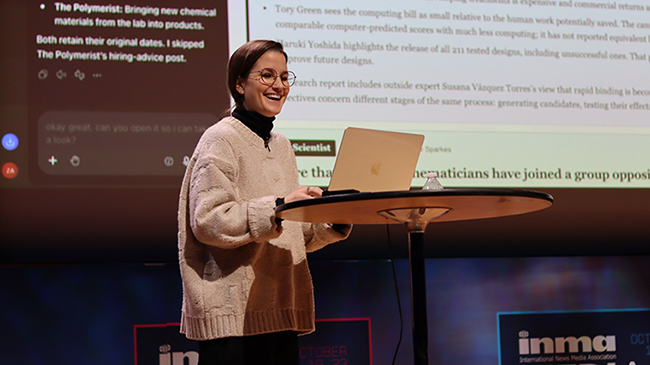
She calls herself “100% a product of the Millennial optimism era.” And she pays for news, which by our industry’s standards makes her practically a unicorn. We all know the average paying reader is way older.
Until 12 to 18 months ago, Julie got all her news from social media. Then Twitter stopped being useful.
“You go on any of these platforms and it’s all fake,” she said. “Nothing is real there.”
So she did exactly what we keep hoping young people will do: “I basically said: OK, I’m an adult now. What am I doing?” She bought a Financial Times subscription.
Her plan was beautifully old-fashioned — almost a little romantic: “I’m going to sit down and read the news, just like my parents. Let’s do it.” Followed, a beat later, by: “But I didn’t do that. Shocker.”
Lost in the foam pit
What happened next will sound familiar to anyone who has ever sat in on a user test.
Julie, who does UX for a living, landed on the FT homepage and “didn’t even know where to start.” There was a button for “your list,” but she couldn’t find the list. There was “add to myFT,” but nobody had ever told her what myFT was. The media and culture stories she actually cared about sat so far down the page that she never got there. And she kept getting logged out.
“I understand why my bank logs me out. I understand why my medical chart logs me out. But why does the Financial Times log me out?”
To be very clear, this is not FT-bashing. I’ve clicked through enough news sites to know this is the reality almost everywhere.
When I asked the room why we log out our customers, the answers came quickly and honestly: Legal calls it best practice, vendors require it, authentication still runs on cookies. One executive said he regularly overrules his legal team but never his cybersecurity people, and given the risks, I understand him.
Another audience member summed up the other side of that trade-off in three words: “Users hate it.”
Julie compared the experience to the foam pits in children’s play gyms. You jump in happily, and then you spend all your energy trying to climb back out. There was no end to it and no feeling of being done.
So she built her own way in
Somewhere between six and 12 months ago, Julie spent about 10 hours building what she very lovingly calls her Brain Rot Bot. With today’s tools, she estimates, it would take three. (I would assume with not as many tech skills as Julie, maybe still five to eight).
It runs locally, signed in through her own browser, and it reads everything she pays for: the FT, her Substacks, and some chosen blogs. It also pulls in conversations from her Twitter feed, so she gets, as she put it, “the benefits of Twitter without having to expose myself to Twitter.”
The bot sorts everything into categories she defined herself (World News, Media and Culture, Laurel Strategy, Laurel Science, Health) and summarises it in short, tweet-like posts. When a statistics-heavy Substack goes over her head, she asks it to “dumb this down a couple of notches.”
She has banned slop-speak and told it to check hyped claims against sources outside Twitter. Every morning, coffee in hand, she works through the list until nothing is left.
“With this, I literally get to zero every day.”
She still clicks through to about two full articles a day. Otherwise, she doesn’t visit the FT anymore.
Let that sink in for a moment. A young, curious reader who willingly pays for quality journalism has moved her whole relationship with it into a tool she wrote herself. The FT still has her money. It no longer has her habit, her attention, or her morning coffee.
“I would definitely unsubscribe”
The day before Julie’s session, we had spent an entire afternoon on blocking bots and scrapers. So I asked her what she would do if the FT blocked her bot tomorrow.
“I would definitely unsubscribe because I don’t think I’m getting $500 a year of value, or whatever insane amount I pay for it.”
What struck me even more was what she said next, because she made the publisher’s argument for us:
“But why would they block me? I guess they can’t tell that I’m not scraping the whole site and posting it on the dark Web. I don’t know how it works. But I feel like I’m doing everything the right way, as an ideal user.”
Both sides have a point here. An audience member reminded us that the FT’s terms of service, like those of most major publishers, explicitly prohibit this kind of automated access, even for logged-in subscribers. And yet the person breaking those terms is precisely the customer every subscription strategy in that room was designed to win.
On our closing podcast, Robert asked me straight out whether I would let in agents that read what their owners have paid for. I said yes, though I admit I had to think about it.
His objection is real: A publisher can’t yet tell whether a subscriber’s agent is quietly feeding somebody’s training run.
But “we can’t tell them apart yet” sounds to me less like a strategy and more like a to-do list. Jodie even had a first glimpse of the answer: A publisher had e-mailed her that week to say it had built an MCP connection for authenticated subscribers, the first one she had come across.
Why this is a young audiences story
You could argue Julie isn’t a typical reader, and she said so herself: Her company gives her very specific information needs. But that is exactly the point. If our products don’t work for a 34-year-old who is interested in news, happy to pay, and literally trained in UX, how are they supposed to work for a 22-year-old who never arrived in the first place?
The Digital News Report 2026 is unambiguous here: 52% of 18- to 24-year-olds name social media, video platforms, or AI as their main source of news, and 56% of young people who don’t read news today have never regularly done so.
They didn’t leave us. They simply never came.
And when they do show up, they meet a product Julie described better than most consultants could: “It doesn’t really feel like the UX of a newspaper has changed at all in the last 50 years. It’s the same thing but on the Internet: a front page and some sections. Instead of turning a page, you click.”
There is good news hidden in all of this. When someone in the audience asked whether her bot would trap her in a bubble, Julie said she deliberately feeds it opposing views. What she misses is the full story, the reporter taking her on a journey.
“Where I do feel sad inside is that I don’t read the full story,” she said, before adding: “I think the really good ones will still break through.”
The editor’s old job of telling people what they didn’t know to ask doesn’t disappear in an agent world. It just has to work inside someone else’s interface.
If you’d like to subscribe to my bi-weekly newsletter, INMA members can do so here.
Banner photo: Adobe stock image by Resky.
Related Articles
-

The audience ABC turns agents, bots, and consumers into product...
11 November 2026 -

Marketers should outsource tasks, not thinking
25 October 2026 -

Bundling is a pricing decision, rebundling is an organisational...
18 October 2026 -

AI’s effect on super user math
15 September 2026 -

The front door is gone — and Asia-Pacific publishers are rebuil...
26 August 2026 -

At Mediacorp’s CNA, loyalty means giving audiences a reason to ...
20 August 2026 -

Tribun Network turns print “dots” into AI-powered insight
20 August 2026 -

Nation Media Group focuses editorial strategy on stories that m...
4 August 2026
Upcoming Events
-

Subscriber Acquisition Master Class
10-17 November 2026
-

Media Advertising Summit
New York, United States
07-10 December 2026
-

AI-Native News Product Master Class
02-09 February 2027
-

Media Subscriptions Summit
Oslo, Norway
08-12 March 2027
-

World Congress of News Media
New York, United States
25-30 April 2027
-

Branded Content & Partnerships Master Class
20-27 May 2027
-

Subscriber Retention Master Class
17-24 June 2027
-

Conferencia Latinoamericana
15-16 July 2027
-

South Asia News Media Festival
New Delhi, India
19-22 July 2027
-

Asia/Pacific News Media Summit
19-20 August 2027
-

CEO Roundtable at Kilkenny
Kilkenny, Ireland
24-26 August 2027
-

Media Innovation Week
Amsterdam, The Netherlands
27 September - 01 October 2027