

Newsrooms look to product thinkers as AI reshapes hiring
Newsroom Innovation Initiative Blog | 05 November 2026

At the recent “unconference” Newsgeist this year, one session that provoked much discussion was on how newsroom leaders are hiring in the age of AI. Speakers included newsroom and product leaders who hire and train staff, as well as academics who teach journalism.
Rather than looking for people with particular interests and skills, we should be thinking more broadly, our room at Newsgeist decided.
Mindset
New hires should possess or be willing to develop “meta competencies,” such as self-awareness and adaptability, many participants said.
“They must be open to learning how to learn, learning to always further develop what they do because yes, now it’s video, audio, AI, and now it’s working with agents. What is it in five years? Is it still the same? So, you have to have people who, on the one hand, have a good way of self-managing and always keeping up to date, and on the other hand, you have to have people that can help others to grow.”
Another participant said: “We have one young journalist, and he’s quite good at reporting. But I think we are not going to hire him full-time because you can’t tell him anything. He always say, oh yes, I know how to do it.”
Another participant listed curiosity, stamina, and resilience as vital skills.
Product thinking is also a valuable, underrated skill in an AI-assisted era where anyone in the newsroom can build a tool, a speaker said: “Just because you have access to a tool that allows you to build it doesn’t turn you into a product builder” because you need to ask the right questions to build the right products.
Another speaker referred to a presentation by consultant Dmitry Shishkin, who pointed out that “your next editor should have built a product.”
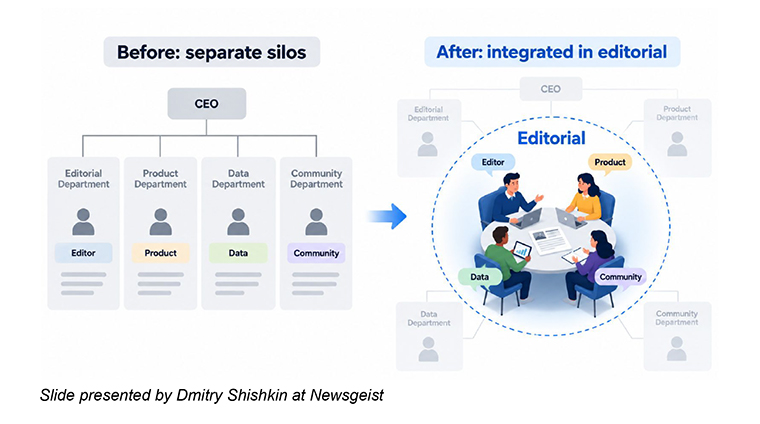
Others asked deeper, existential questions.
Do we need editors?
“Imagine a world where a journalist is only the contact system to what we call reality. Everything else is done by AI. You just deliver the facts. Everything else is liquid content. It’s flowing out of the systems in the background,” said one participant.
“What’s the core purpose of a homepage these days, and what’s our off-premise presence, and what’s that purpose? How do we interlink the roles in a new way and the technology in a new way?” another speaker asked.
Do we need newsrooms?
“Is a newsroom the right structure?” one speaker asked. “Or is the newsroom, especially for local publishers, maybe a problem because journalists sit next to each other in the newsroom every day? We all know journalists talk to each other, not to the ugly reader. We have to go to communities. Maybe the newsroom itself is a problem.”
Delivering on our value proposition
We need to understand what we are delivering to our audience before we can hire people to do the work, participants pointed out.
“We’re not in the information business; we’re in the business finding stuff out and generating ‘aha’ moments in some way,” one leader said. “Reporters in the field are super essential in the instrument of the future, and original voices are also very important.”
In other words: What are your staff members doing that AI cannot replicate easily?
“You have to determine what identity your newsroom is going to have. What is your mission and what are your values?” another speaker said.
“You can’t figure that out unless you know what the core journalistic contribution is that you want a person to be making. I think a lot of times we’re kind of afraid to define that, so we mess around the edges of like, oh well, they should be able to shoot video and write social media, but that doesn’t get at the core.
“What is the core value added? How is that person furthering your defined mission in this new fluid context?”
If you’d like to subscribe to my bi-weekly newsletter, INMA members can do so here.
Banner photo: Adobe stock image by Andrey Popov.
Related Articles
-

The audience ABC turns agents, bots, and consumers into product...
11 November 2026 -

Marketers should outsource tasks, not thinking
25 October 2026 -

AI is now media’s operating environment
28 September 2026 -

AI’s effect on super user math
15 September 2026 -

At Mediacorp’s CNA, loyalty means giving audiences a reason to ...
20 August 2026 -

Tribun Network turns print “dots” into AI-powered insight
20 August 2026 -

Nation Media Group focuses editorial strategy on stories that m...
4 August 2026 -

Briefly News empowers journalists with AI tool suite Nova
4 August 2026
Upcoming Events
-

Media Advertising Summit
New York, United States
07-10 December 2026
-

AI-Native News Product Master Class
02-09 February 2027
-

Media Subscriptions Summit
Oslo, Norway
08-12 March 2027
-

World Congress of News Media
New York, United States
25-30 April 2027
-

Branded Content & Partnerships Master Class
20-27 May 2027
-

Subscriber Retention Master Class
17-24 June 2027
-

Conferencia Latinoamericana
15-16 July 2027
-

South Asia News Media Festival
New Delhi, India
19-22 July 2027
-

Asia/Pacific News Media Summit
19-20 August 2027
-

CEO Roundtable at Kilkenny
Kilkenny, Ireland
24-26 August 2027
-

Media Innovation Week
Amsterdam, The Netherlands
27 September - 01 October 2027
-

Rebuilding the Newsroom Master Class
07-14 October 2027